FROM SEDER to SEDER
Recipes, Rituals and the Narrow Places in the Heart

Every spring, as the last crumbs of Purim’s hamantaschen and noisemakers disappear, the mayhem finally behind me, I feel a familiar tug: Passover is coming. Even if you have never hosted a seder (the ritual Passover meal), you might know the mix of dread and tenderness that comes with any big family gathering—menus to plan, guests to welcome, stories to remember. For me, what looks like a week of cooking and cleaning is really a journey through old recipes, loved ones’ handwriting, and the ways we try to free ourselves, year after year.
Who is coming for seder? What are my menus for the eight days? Not to be misguided by the labor involved in celebrating this holiday, I embrace much more than the work.
To begin with, the profound meaning of the holiday is foremost. In the Jewish daily prayer, we are commanded to remember the Passover, to remember that we were slaves in Egypt. How we enslave ourselves is front and center.
I remember a person with great insight teaching that “mitzrayim,” the word we use for “Egypt,” actually means “narrows.” We are taking the puff out of everything and attempting to pass through those narrows in ourselves: our biases, assumptions, narrow judgments, our egos and the ways we fool ourselves. It is like the way we empty our hearts and minds—and pockets—of lint six months earlier on Rosh Hashanah.
So I labor in the meaning of the holiday and, for the purpose of this essay, I explore and relish my memories and recollections of people I love.
My mind is abuzz with lists while I review inventories and develop a cleaning schedule. Shopping lists, directories of shopping places, shopping days are enumerated, cooking timetables classified and ordered. It is a mouthwatering chaos born of eagerness and expectancy.
From a high shelf I retrieve my Passover recipe box. Lifting the lid, I feel a rush of familiarity. My eyes regard the farrago of papers, index cards, and clippings. I paw through the jambalaya of recipes: Persian, Surinamese, and Ashkenazi charosets; Roman, Greek, and Yemeni artichokes; Tunisian soup with lamb; cilantro-flecked matzah balls; megina—Turkish matzah pies; Bulgarian boumuelos; Russian latkes; Venetian tortes; Spanish sponge cake.
Among the recipes snipped and culled from now-anonymous magazines and newspapers are the frayed and stained sheets of stationery, notebook paper, and cards in the distinct handwriting of my mother and grandmother.
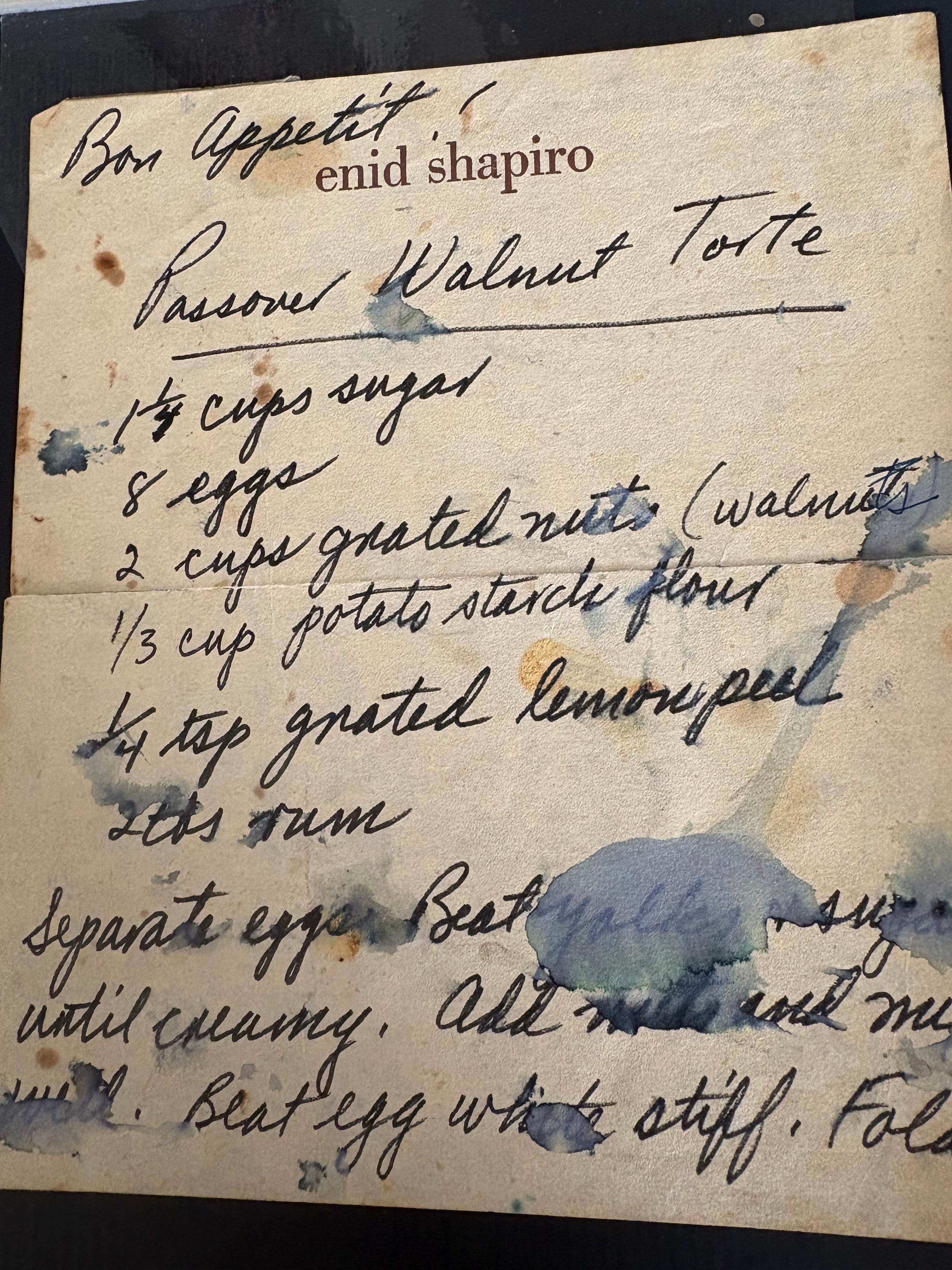
Today, recipes are digital documents, put into computer files, emailed to one another or downloaded from internet sites. Not these recipes. My mother’s “Passover Walnut Torte” is written in her handwriting—I would know it anywhere—on fawn-colored stationery. Her name is embossed in script across the top and she added a personal handwritten note: “Bon Appétit.” The page is severely creased, with two blemishes—misshapen water stains like tears—and I treasure them as I would a kiss or caress between us. I can smell her torte baking in a springform pan in the oven of my childhood kitchen.
A dark orange 3×5 card is printed: “From the kitchen of…” and she has added her first and last name in her distinct handwriting that instantly evokes her, describing her as handwriting expertly does. Her attractive, sure hand is purposeful: she held cancer at bay for more than 40 years, made a new life after my father’s death, traveled, worked, and continued to do good deeds. I am still following her recipes.
While my paternal grandmother’s kugels linger on my taste buds, joined to memories of my index finger squishing into her macaroon batter, my maternal grandmother was not much of a cook, yet nestled in my Passover box on a sheet of yellow paper is “Nana’s Tzimmis,” written in her characteristic script.
Her penmanship is clear, certain, and strong, as she was. Born in 1900, one of eight children, she marched for women’s suffrage in 1919. Widowed early, she still made certain my mother had a college education. In her late fifties she reinvented herself when she remarried and relocated to Toronto. She became a force in Hadassah and was able to pursue her passions: painting and playing piano into her eighties. Cooking was not one of her talents, yet her tzimmis is on the menu every year. Made with prunes and carrots, sweet potatoes and pineapple, it is hard to mess up or improve upon.
Unpacking other Passover boxes sequestered since last year, I meet characters that reside alongside the strong women in my recipe box. I have the first matzah “plate” my son made. It consists of a square shoebox lid taken to preschool and pasted with thin floral paper.
There is my daughter’s first Haggadah assembled from different colored construction papers, illustrated with her childhood drawings: scenes of the Ten Plagues (will we discuss pandemics and plagues this year?), the crossing of the Red Sea. Enfolded gingerly in tissue paper is the Elijah’s Cup we bought on our first family trip to Israel and the cup for Miriam my parents gave us before my father’s death. These are the enduring guests at my seder table, treasured, steadfast visitors and permanent callers.
The apogee is a piece of matzah from last year’s seder tucked into an afikomen pouch, also a gift from my parents. My father-in-law observed a custom at the end of each seder meal: he took a piece of his portion of the afikomen, folded it in a napkin, and placed it in his breast pocket, that we should all be kept in one piece—intact—by his heart until the next seder meal.
At home afterward, he placed the wrapped piece of matzah in the back of the top drawer of his bureau. The last time he performed this ritual is now many years ago. He died two days before Passover, and I perpetuate his custom. I keep him in my heart (always) and consecrate his memory annually when I open my Passover box and find the piece of matzah I squirreld away at the end of the eight days last year. Unleavened bread gives rise to so much emotion and lifts me out of my mundane pursuits.
These characters—literally the handwriting and the ritual companions—are my GPS as I navigate from year to year, from seder to seder. The notes take me across time. They are the signs on the doorposts of my life and the visitors to my table. They are my chaperones at and through seder to seder. L’dor v’dor—from generation to generation. I pass through the yearly yummy gates, the recipes standing like sentinels guarding my memory and instructing me; the ritual objects reminding me of life’s recipes and joy.
My children and their friends, many of them millennials wandering in the desert of mixed marriages and agnosticism, will join us. They will take their places among my ritual companions, my trusty guests, enduring, dependable, and unwavering, from whom they will take many cues and many clues while smacking their lips with every taste.